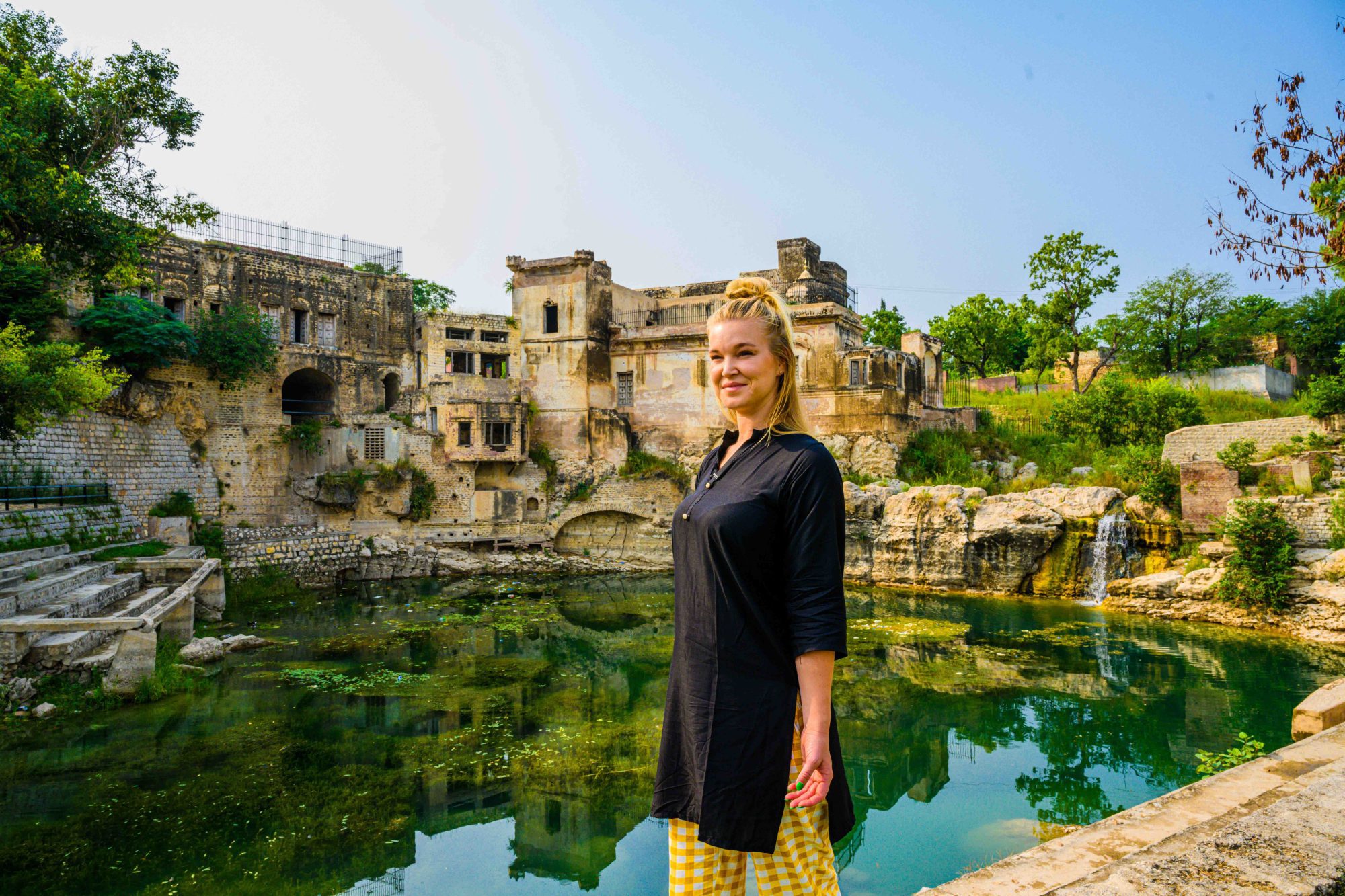
When you think of Hindu temples, Pakistan might not initially spring to mind, but Shri Katas Raj Temple is definitely somewhere you should know about.
Tucked into the dusty folds of the Salt Range in Punjab, Shri Katas Raj Temple sits around a pond so green it looks almost unreal. The story goes…that it was filled by the tears of the Hindu god Shiva, who wept inconsolably after the death of his wife, Sati. The Pandava brothers of the Mahabharata supposedly spent part of their exile here, and the stones themselves go back well over a thousand years. It’s a place full of history.
It’s one of the most important Hindu pilgrimage sites in Pakistan, although I was told that only around 120 Hindus are given religious visa permits each year to visit here.
1500 years old, located in the salt hills, and barely a tourist in sight. Here’s everything you need to know before you visit Shri Katas Raj Temple in Pakistan.

The sacred pond: where Shiva wept
Everything at Katas Raj revolves around the pool. Quite literally, as the temples are arranged in a loose ring around its edge.
The story goes that when Shiva’s wife Sati died, he was so consumed by grief that his tears fell to earth in two places. One formed the holy lake at Pushkar in Rajasthan. The other formed this pond. In fact, the name Katas is thought to come from Kataksha, meaning “tear-filled eyes”. The temples reflect in the jade-coloured water with the bare salt hills rising behind.
For pilgrims, a dip in these waters is deeply auspicious. When I visited, I didn’t see anyone dipping in the water here, so I’m not sure if it’s still allowed. That being said, I was the only tourist there that day, as everyone else appeared to be local people just hanging out.

Visiting Katas Raj Temple: practical info
| Location | Kallar Kahar Road, Katas, near Choa Saidan Shah, Chakwal District, Punjab |
| Opening hours | 9am–6pm daily (can close around 5pm in winter) |
| Entry fee | Free |
| Other fees | Occasional nominal parking or maintenance charge of around PKR 20 |
| Local guide | Around PKR 1500 – 5/6 dollars |
| Time needed | 2 hours; or half a day with Khewra Salt Mine |
| Best time to visit | October to March |

Getting to Shri Katas Raj Temple
Driving to Katas Raj from Lahore or Islamabad
Katas Raj is about a 2.5-hour drive from either Islamabad or Lahore, just off the M2 motorway. Public transport is patchy, so most people hire a car or a car & driver.
The easy win is to pair it with the Khewra Salt Mine, the second-largest salt mine in the world and a properly surreal experience in its own right. Kallar Kahar Lake is also nearby if you want to stretch it into a full day.
Organised day tours
If you’d rather someone else handled the logistics, plenty of operators run day trips from Islamabad and Lahore, usually bundling Katas Raj with Khewra and sometimes Kallar Kahar. Expect to pay roughly US$100–250+ per person, depending on group size and whether transport, tolls and a private guide are included.
This well reviewed trip takes you to Shri Katas Raj as well as Khewra Salt Mine from Islamabad.
Click here to book an organised tour from Islamabad to Shri Katas Raj Temple.
This trip to Shri Katas Raj Temple from Lahore has very good reviews and takes you to Shri Katas Raj and Khewra Salt Mine.
To book a tour from Lahore click here.
When to go
Aim for October to March. It is open pretty much all year round, but the Salt Range gets fiercely hot in summer, and there’s very little shade around the pond.
If you want to see the site at its most alive, time your visit for Maha Shivratri (usually February or March). During this time some Hindu pilgrims, including groups from India, travel here for the festival. Expect some crowds and tighter security, but also a rare chance to see the temples doing what they were built to do.


Katas Raj FAQs
Is there an entry fee for Katas Raj Temple?
No, entry is free. You may occasionally be asked for a small parking or maintenance fee of around PKR 20.
How old is Katas Raj?
The site’s origins go back well over a thousand years, with temples built across several different eras.
How far is Katas Raj from Islamabad?
About 2.5 hours by car via the M2 motorway from Islamabad. It’s about 3.5 hours from Lahore.
Can you visit Katas Raj and Khewra Salt Mine in one day?
You can yes, and many tours offer trips that include both the temples and Khewra Salt Mine, but be prepared for a long day.

A place worth protecting
Katas Raj hasn’t had an easy few centuries. Long stretches of neglect took their toll on the temples, and more recently the sacred pond itself began to shrink as groundwater levels in the area fell. Heavy water use by nearby industry, including cement factories has been widely blamed.
The drying pond became a national story, prompting legal action and conservation work to protect both the water and the buildings. It’s a good reminder that this isn’t a museum piece. It’s a living sacred site, and a fragile one.
I was disappointed to see that there was a lot of graffiti and litter around the temples. Our guide (and I) did try to pick up litter but he said it’s very hard to keep on top of it.
So visit respectfully. Keep in mind what to wear in Pakistan and dress modestly, take your shoes off where asked, and keep your voice down around worshippers. If you can, hire a guide to help you understand the stories, the history and architecture here.


The temples and the legends
The complex is a glorious jumble of eras. At its heart is the Satgraha, a group of seven old temples, built in the north Indian shikhara style with their distinctive tapering towers. Most sit on square platforms, their tiers stacked with little rows of pillars and capped with ribbed domes.
Scattered around them you’ll find medieval shrines, a haveli, a handful of newer temples and the remains of a Buddhist stupa, although much of it is weathered and crumbling at the edges.
The Pandava brothers are said to have spent part of their 12-year exile here, and local tradition credits them with building the Satgraha. The pond is also linked to one of the Mahabharata’s best-known episodes: the riddle of the Yaksha. Four of the brothers drank from the pool without answering a spirit’s questions and fell dead. Only Yudhishthira stopped to answer, and his wisdom brought them back to life.
Katas Raj has long been revered. When Alexander Cunningham, the first Director General of the Archaeological Survey of India, visited in 1872–73, he described it as the second most important Hindu pilgrimage site in Punjab, after Jwalamukhi.
Final thoughts on visiting Shri Katas Raj Temple
I understand the privilege of me being able to visit Shri Katas Raj Temple on my first time in Pakistan when many of my Indian friends wanted to but were not able to. There are no crowds jostling for selfies here, it’s a beautiful but quiet site that is unfortunately falling into disrepair.
If you’re travelling through Punjab, it’s well worth the detour. Visit while you can.
